|
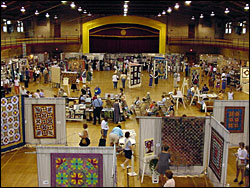
Gallery Talks To increase visitors' understanding of, and appreciation for, our exhibits, the Festival is pleased to present daily gallery talks about each of the principal exhibits. The curators or other knowledgeable Festival staff will offer informal 30 to 45 minute talks once or twice each day, and answer questions about the quilts. A complete schedule of talks will be printed in the Festival catalogue, and posted in both Plumley Armory and Shapiro Field House. There is no charge for the gallery talks. The gallery talks are underwritten by Dorr Mill Store of Guild, NH, and the East Barre Antique Mall of East Barre, VT.
|
|||||
 |
|||||
|
Available at the VQF: Plain and Fancy Plain and Fancy: Vermont's People and Their Quilts, a beautiful and informative work about quilts from Vermont, features 45 quilts made here between 1780 and 1940. Over fifty color and fifteen black and white photos of these distinctive quilts, which range from the plainest everyday to the fanciest kept-for-best, are included. The 104-page text relates the quiltmakers' stories to events taking place in Vermont and the United States at the time. Plain and Fancy will be on sale at the Festival. Discounts are available for quantity purchases by guilds, individuals and shops. This offer is good while the VQF's copies last. For more information and order forms, write VQF Plain and Fancy, PO Box 349, Northfield, VT 05663-0349, or e-mail us at [email protected]. |
|||||

|
Pioneers: Teaching the World to Quilt
By Nancy Halpern There may have been a time when everyone learned to quilt at their mother's knee. With rare exceptions, however, this is no longer true. Indeed, it was also rare for those teachers whose careers began 20 and 30 years ago to have absorbed quiltmaking from a family member or an older generation. Few even had legitimate teaching credentials. Yet our brilliant, contemporary quilt movement is a testament to the interplay of inspired teachers and inspiring students, mutually guiding, encouraging, trouble-shooting, rediscovering old tricks and inventing new techniques. Most of these teachers started with local classes, and some in this exhibit have remained happily within a close regional network of eager beginners and loyal advanced students. Others moved to a national and then international stage, or shared their expertise through publications and television. Many who began as generalists - teaching color, design, and every possible technique - now focus on a specialty that reflects their own particular passion or talent. This could be technical, like quilting, appliqué, meticulous piecing or fabric dyeing. Perhaps they brought to new heights some aspect of traditional quiltmaking, like log cabin, crazy quilts or curved seams. Their inspiration may have come from an indigenous medium - Seminole patchwork, San Blas molas, Hawaiian or Celtic design. Or they may have found ways of gloriously reinterpreting the oldest of all quilt traditions, clothing. Perhaps the exciting and fertility of today's quiltmaking has come from the very fact that our teachers were learning as they taught. "Just try to keep one step ahead of your students" was the mantra of many a novice (and nervous) teacher. No teacher in this show has failed to eloquently cite their indebtedness to their students. We have all enjoyed this enthusiastic, inexhaustible reciprocity. Our learning curve continues to ascend - once and future stars, enlivening and expanding our firmament together. Nancy Halpern of Natick, MA, is a leading American quiltmaker who has been practicing her art since the mid-1970s. She is Curator of "Pioneers", and also served as Curator for three previous special exhibits at VQF: "Wool Quilts of New England," in 1984; "Last Quarter, Twentieth Century," in 1999; and "Quilts of Molly Upton," in 2000.
|
|||